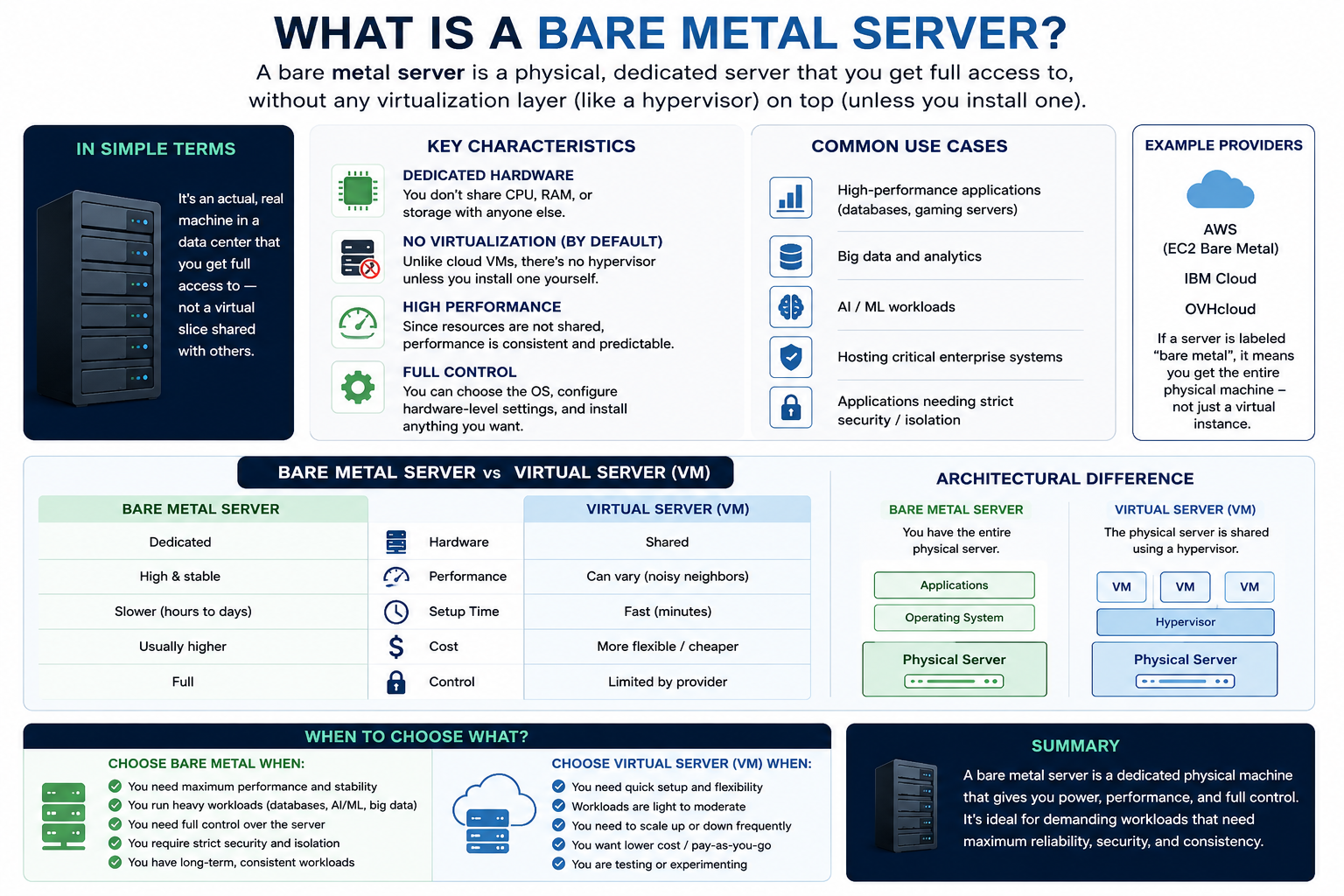

A bare metal server is a physical, dedicated server that is used by a single customer, without any virtualization layer (like a hypervisor) sitting on top.
In simple terms:
It’s an actual, real machine in a data center that you get full access to — not a virtual slice shared with others.
Key characteristics:
- Dedicated hardware
You don’t share CPU, RAM, or storage with anyone else. - No virtualization (by default)
Unlike cloud VMs, there’s no hypervisor unless you install one yourself. - High performance
Since resources are not shared, performance is consistent and predictable. - Full control
You can choose the OS, configure hardware-level settings, and install anything you want.
Bare metal vs Virtual server (quick comparison):
| Feature | Bare Metal Server | Virtual Server (VM) |
|---|---|---|
| Hardware | Dedicated | Shared |
| Performance | High & stable | Can vary |
| Setup time | Slower | Fast |
| Cost | Usually higher | More flexible/cheaper |
| Control | Full | Limited by provider |
Common use cases:
- High-performance applications (databases, gaming servers)
- Big data and analytics
- AI/ML workloads
- Hosting critical enterprise systems
- Applications needing strict security/isolation
Example:
If you rent a server from providers like AWS (EC2 Bare Metal), IBM Cloud, or OVH, and it’s labeled “bare metal”, it means you get the entire physical machine—not just a virtual instance.
You must be logged in to post a comment.