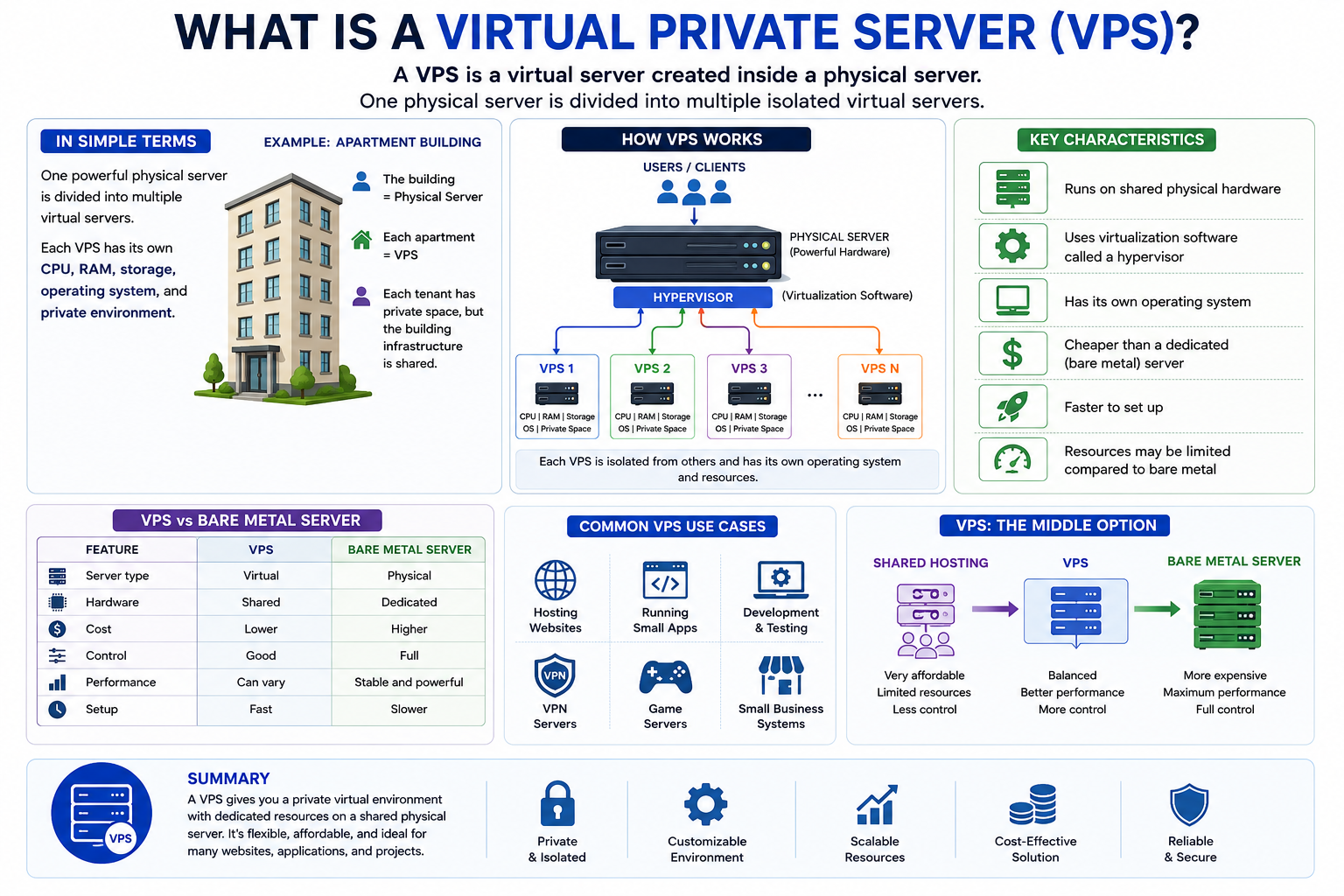
A Virtual Private Server (VPS) is a virtual server created inside a physical server.
In simple terms: one powerful physical server is divided into multiple smaller virtual servers. Each VPS gets its own CPU, RAM, storage, operating system, and private environment.
Example
Imagine one apartment building:
- The building = physical server
- Each apartment = VPS
- Each tenant has private space, but the building infrastructure is shared
VPS characteristics
- Runs on shared physical hardware
- Uses virtualization software called a hypervisor
- Has its own operating system
- Cheaper than a dedicated or bare metal server
- Faster to set up
- Resources may be limited compared to bare metal
VPS vs Bare Metal Server
| Feature | VPS | Bare Metal Server |
|---|---|---|
| Server type | Virtual | Physical |
| Hardware | Shared | Dedicated |
| Cost | Lower | Higher |
| Control | Good | Full |
| Performance | Can vary | Stable and powerful |
| Setup | Fast | Slower |
Common VPS use cases
- Hosting websites
- Running small apps
- Development and testing
- VPN servers
- Game servers
- Small business systems
A VPS is a good middle option between shared hosting and a dedicated bare metal server.