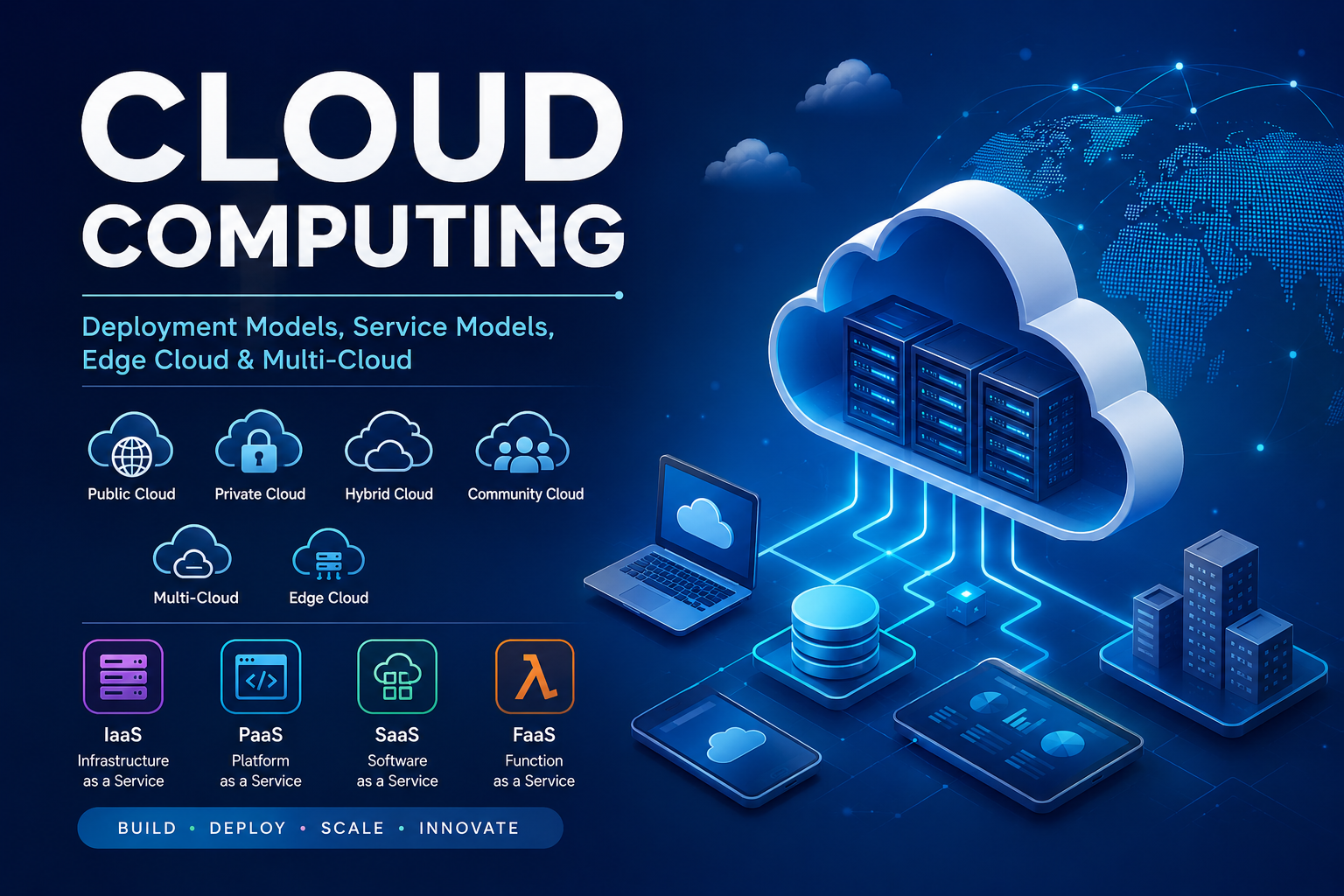
Cloud computing has transformed how organizations build, deploy, and manage applications and infrastructure. Instead of owning and maintaining physical servers, businesses can access computing resources over the internet on demand.
According to Wikipedia and standard cloud computing references, cloud concepts are generally divided into deployment models and service models. Modern cloud architectures also include concepts such as Edge Cloud and Multi-Cloud.
What Is Cloud Computing?
Cloud computing is the delivery of computing services such as servers, storage, databases, networking, and software over the internet.
Rather than buying hardware and managing everything locally, users can rent resources from cloud providers and scale them as needed.
Popular cloud providers include:
- Amazon Web Services (AWS)
- Microsoft Azure
- Google Cloud Platform (GCP)
- IBM Cloud
- Oracle Cloud
Cloud Deployment Models
Deployment models describe who owns the cloud infrastructure and how it is accessed.
1. Public Cloud
A public cloud is operated by a third-party provider and shared among multiple customers over the internet.
Examples:
- AWS
- Microsoft Azure
- Google Cloud
Characteristics
- Shared infrastructure
- Pay-as-you-go pricing
- Highly scalable
- Easy to deploy
Common Uses
- Web hosting
- Mobile applications
- Startups
- SaaS applications
Advantages
- Low upfront cost
- Fast deployment
- Global availability
Disadvantages
- Less infrastructure control
- Shared environment
2. Private Cloud
A private cloud is dedicated to a single organization.
It may run:
- On-premises
- In a private data center
- On dedicated bare metal infrastructure
Characteristics
- Dedicated resources
- Higher security and control
- Customizable infrastructure
Common Uses
- Banking
- Government systems
- Healthcare
- Enterprise internal platforms
Advantages
- Better compliance
- Greater control
- Improved security
Disadvantages
- Higher cost
- More operational complexity
3. Hybrid Cloud
A hybrid cloud combines multiple deployment models, typically public and private cloud environments.
Example:
- Sensitive data in private cloud
- Public-facing applications in public cloud
Characteristics
- Mixed infrastructure
- Flexible workload placement
- Shared orchestration between environments
Common Uses
- Disaster recovery
- Data backup
- Enterprise modernization
Advantages
- Flexibility
- Cost optimization
- Better scalability
Disadvantages
- Complex management
- Networking challenges
4. Community Cloud
A community cloud is shared by organizations with similar operational or compliance requirements.
Examples:
- Universities
- Government agencies
- Healthcare organizations
Characteristics
- Shared infrastructure
- Common compliance policies
- Collaborative environment
Advantages
- Shared cost
- Shared governance
Disadvantages
- Limited flexibility
- Smaller scale than public cloud
Modern Cloud Architecture Models
These models extend traditional deployment concepts.
5. Multi-Cloud
Multi-cloud means using services from multiple cloud providers simultaneously.
Example:
- AWS for compute
- Azure for identity management
- Google Cloud for AI workloads
Characteristics
- Multiple providers
- Distributed workloads
- Reduced vendor dependency
Advantages
- Avoid vendor lock-in
- Better resilience
- Provider specialization
Disadvantages
- Operational complexity
- Multiple billing systems
- Cross-cloud integration challenges
6. Edge Cloud (Edge Computing)
Edge cloud places computing resources closer to users or devices instead of relying entirely on centralized cloud data centers.
Example
Traditional cloud:
User → Internet → Central cloud data center
Edge cloud:
User → Nearby edge node → Faster response
Characteristics
- Low latency
- Local processing
- Distributed infrastructure
Common Uses
- IoT
- Smart cities
- Online gaming
- Video streaming
- Autonomous vehicles
- 5G networks
Advantages
- Faster response time
- Reduced bandwidth usage
- Better real-time performance
Disadvantages
- Distributed management complexity
- Security challenges
Cloud Service Models
Service models describe what level of service the cloud provider offers.
1. Infrastructure as a Service (IaaS)
IaaS provides virtualized computing resources such as:
- Virtual machines
- Storage
- Networking
Users manage:
- Operating systems
- Applications
- Middleware
Provider manages:
- Physical infrastructure
Examples
- Amazon EC2
- Google Compute Engine
- Azure Virtual Machines
Best For
- System administrators
- Infrastructure hosting
- Custom server environments
2. Platform as a Service (PaaS)
PaaS provides a platform for developing and deploying applications without managing underlying infrastructure.
Provider manages:
- Servers
- Operating systems
- Runtime environments
Users manage:
- Applications
- Data
Examples
- Heroku
- Google App Engine
- Azure App Service
Best For
- Application developers
- Rapid deployment
3. Software as a Service (SaaS)
SaaS delivers complete software applications over the internet.
Users simply access the software through a browser or application.
Examples
- Gmail
- Microsoft 365
- Salesforce
- Dropbox
Best For
- End users
- Businesses needing ready-made software
4. Function as a Service (FaaS) / Serverless Computing
FaaS allows developers to run code without managing servers.
Applications execute only when triggered.
Examples
- AWS Lambda
- Azure Functions
- Google Cloud Functions
Characteristics
- Event-driven
- Auto-scaling
- Pay-per-execution
Best For
- APIs
- Automation
- Event processing
Relationship Between Deployment Models and Service Models
Both models work together.
Example:
| Deployment Model | Service Model |
|---|---|
| Public Cloud | SaaS |
| Private Cloud | IaaS |
| Hybrid Cloud | PaaS |
| Edge Cloud | Serverless |
An organization may use:
- Public cloud deployment
- Combined with IaaS and SaaS services
- While also operating edge infrastructure
Bare Metal, VPS, and Hypervisors in Cloud Platforms
Modern cloud platforms are built using virtualization technologies.
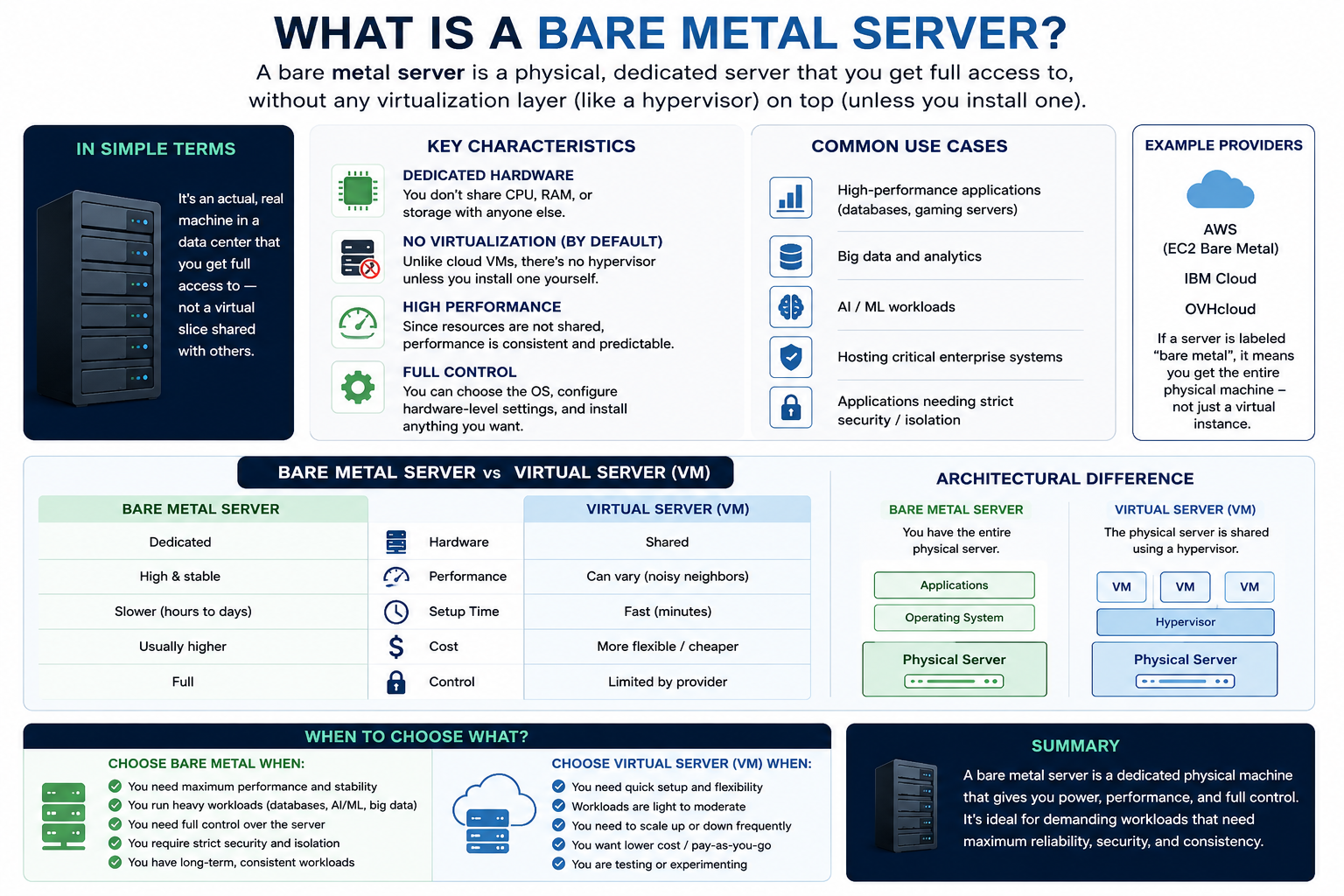
Bare Metal Servers
A bare metal server is a dedicated physical server.
Advantages:
- High performance
- Full hardware access
- Best for cloud infrastructure
Hypervisors
A hypervisor creates and manages virtual machines.
Examples:
- VMware ESXi
- KVM
- Hyper-V
Hypervisors enable:
- VPS hosting
- Virtualized clouds
- Infrastructure sharing
VPS (Virtual Private Server)
A VPS is a virtual machine created using a hypervisor on a physical server.
It provides:
- Isolated environments
- Dedicated virtual resources
- Lower cost than bare metal
Conclusion
Cloud computing includes multiple deployment strategies and service delivery models designed for different business and technical requirements.
Traditional deployment models include:
- Public cloud
- Private cloud
- Hybrid cloud
- Community cloud
Modern cloud architectures include:
- Multi-cloud
- Edge cloud
Cloud service models include:
- IaaS
- PaaS
- SaaS
- FaaS/Serverless
Together, these technologies form the foundation of modern digital infrastructure powering applications, AI systems, enterprise platforms, telecommunications, and internet services worldwide.

You must be logged in to post a comment.